Each child safety seat needs a safety belt or LATCH to hold it in place. LATCH (Lower Anchors and Tethers for Children) is a system designed to make safety seat installation easier.

Check the safety seat instructions and the vehicle owner's manual for tips on using the safety belts or LATCH to install a safety seat (E).
If using safety belts, put the vehicle safety belt through the correct belt path on the child safety seat (see F below). Check the child safety seat instructions or look for labels on the seat that mark the safety belt path. Use the correct belt path for the direction the safety seat is facing.
The child safety seat must stay tight at all times. Check for tight fit by holding the seat at the belt path and by pulling the seat side to side and forward. The child safety seat should not move more than one inch sideways or toward the front of the vehicle.
IS THE HARNESS POSITIONED THE RIGHT WAY AND BUCKLED SNUGLY ON THE CHILD?
The harness straps must fit on strong parts of the body: the shoulders and hips.

Use the correct slots for the harness (F). Using the wrong slots can cause serious injury. Check the manufacturer's instructions for the correct placement of the harness straps.
Keep straps on the child's shoulders, not arms. Keep straps flat on the child's shoulders and snug enough to keep the child from moving forward.
Place the harness retainer clip at armpit level (F).
WHEN IS A CHILD READY FOR THE ADULT SAFETY BELT?
Until age 8, most children have not developed strong hipbones, and their legs and body are too short to allow for proper fit of a safety belt. Safety belts are designed for adults.
To be able to fit in a safety belt, a child must:
Be tall enough to sit without slouching,
Keep his/her back against the vehicle seat back,
Keep his/her knees completely bent over the edge of the seat,
Keep his/her feet flat on the floor, and
Be able to stay comfortably seated this way.
Place the harness retainer clip at armpit level (F).
WHEN IS A CHILD READY FOR THE ADULT SAFETY BELT?
Until age 8, most children have not developed strong hipbones, and their legs and body are too short to allow for proper fit of a safety belt. Safety belts are designed for adults.
To be able to fit in a safety belt, a child must:
Be tall enough to sit without slouching,
Keep his/her back against the vehicle seat back,
Keep his/her knees completely bent over the edge of the seat,
Keep his/her feet flat on the floor, and
Be able to stay comfortably seated this way.

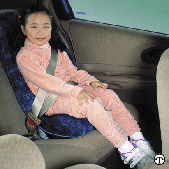
The lap belt must fit low and tight across the upper thighs. The shoulder belt should rest over the center of the shoulder and across the chest (G).
Never put the shoulder belt under the child's arm or behind the child's back. This can cause severe internal injuries in a crash. If the safety belt does not fit properly the child should use a belt-positioning booster seat.
Always check belt fit on the child in every vehicle. A belt-positioning booster seat may be needed in some vehicles and not in others.
ALWAYS read and follow the child safety seat instructions and the vehicle owner's manual!
Never put the shoulder belt under the child's arm or behind the child's back. This can cause severe internal injuries in a crash. If the safety belt does not fit properly the child should use a belt-positioning booster seat.
Always check belt fit on the child in every vehicle. A belt-positioning booster seat may be needed in some vehicles and not in others.
ALWAYS read and follow the child safety seat instructions and the vehicle owner's manual!
By Carjunky